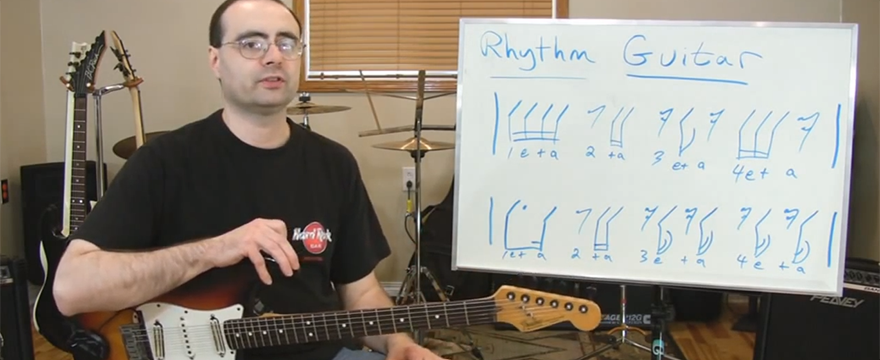
If you feel like you need to brush up on your rhythm skills then you can’t do much better than the study of 16th-note rhythms. Music styles such as funk and soca offer guitarists the chance to build more advanced 16th-note rhythm awareness. This lesson will use funk and soca as a way to help introduce several grooves for improving rhythm /strumming ability…
Q: I have just started playing in my first band and I feel that my rhythm guitar skills are weak. Can you offer me any suggestions for what I can practice on to help my rhythm guitar get better. I have a pretty good idea of the general rhythms in music, like; eighths, sixteenths and triplets, but I find I have trouble maintaining the groove in a really smooth way through an entire song during a band rehearsal?
~ Anthony
A: Guitarists can quickly improve their rhythm guitar skills by working on the syncopated sixteenth-note exercises found in Funk and Caribbean Soca music.
One thing to keep in mind is that rhythm guitar is the main aspect of playing in a band (having solid rhythm is more important than playing great licks and soloing). Think of the most famous players in the world; Clapton, Hendrix, Page, Van Halen, Gilmore… not only are they amazing soloists, but they are equally amazing at rhythm guitar.
Over my many years of teaching guitar, I have noticed that when a guitar student makes a study of sixteenth-note grooves in the styles of Funk and Caribbean music like; reggae, soca and calypso they will rapidly increase their level of skill with rhythm guitar.
These guitar rhythm styles are important because not only do they include chord shots to develop good hand control, but these styles also have a good deal of scratch rhythms to attend to as well. These scratch ideas (sometimes called ghost-notes), require you to mute out string groups and produce a muffled effect which comes across more as a percussive sound.
By training yourself on performing the syncopated sixteenth-note rhythms found in these styles, you will gain a solid sense of control over your left (and more importantly) your right-hand strumming technique.
By working slowly with a metronome and counting the beat as you perform these studies, you will develop the chops necessary to perform these styles perfectly in time.
A by-product achieved through this practice will be the added ability to easily duplicate lines heard on albums, at rehearsals or lines you hear in your head while writing music. No matter what style you want to perform in the long run.
DAILY PRACTICE:
When you begin your day, work on performing steady sixteenth-notes in time with a metronome. Select a chord, turn on your metronome at a slower pace and begin playing the chord in perfect time.
Work on developing both scratch technique as well as performing without. Next, move on to performing a series of rhythm guitar exercises. One measure studies tend to work the best.