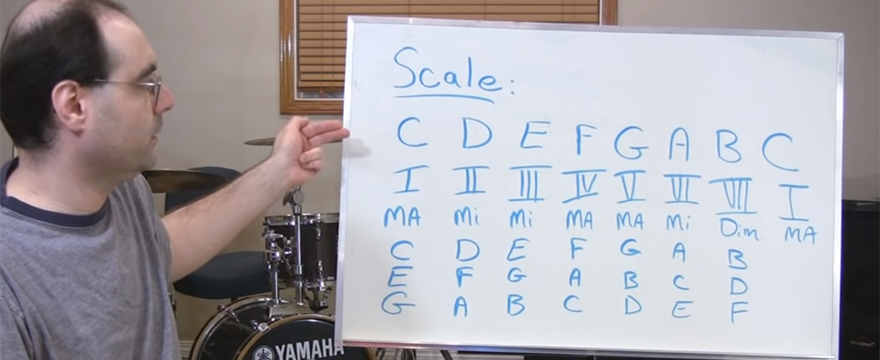
Every key in our musical language can be used for creating both single-note melody, as well as, chord progressions. In this lesson, I discuss how a single-note scale can be harmonized to create a series of chord types that all function within the same key signature. This topic is referred to as, “Diatonic Harmony.”
HARMONIZING THE MAJOR SCALE:
The foundation of diatonic harmony is triad harmonization of the major scale. To begin researching this topic – take a moment to learn a few important definitions.
– Diatonic:
The term diatonic is the opposite of chromatic. Since chromatic is non-selective movement between notes, diatonic is obviously selectively moving in a specific way from one note to another.
– Harmony:
When we combine notes in third intervals one on top of another we achieve harmony from a scale. For example; if we had a C Major scale, all notes being natural, and we moved up a 3rd from C – we would land on E. Another 3rd after that would give us G. Therefore the notes of C, E and G are all in harmony.
– Diatonic Harmony:
When we stay inside of a scale and play the chords found within that central tonality, we achieve Diatonic Harmony.
NOTE:
Since; pop, rock, country, folk and other popular styles are generally created from a single harmonized scale, it is vital that we fully understand this process.
Harmonized scales are also important in understanding the relationship between the melody and the harmony in a musical piece.
If a musician wishes to compose a musical piece, but does not have an understanding of the chords which fit within a specific key, they would have great difficulty matching chord types and chord qualities along with creating melody lines.
HOW TO CREATE A DIATONIC HARMONY:
Below is an example of how the process of harmonizing a “key of C Major” scale evolves from single scale tones into a series of Diatonic Triad Chords:
The “C” Major Scale: C, D, E, F, G, A, B, C
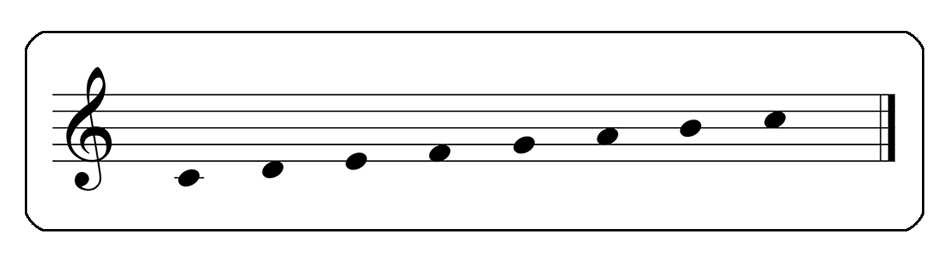
Each step of the scale can be stacked into diatonic third intervals to create a chord harmony for the key, (also referred to as a “Harmonized Scale”).
The Harmonized “C” Major Scale:
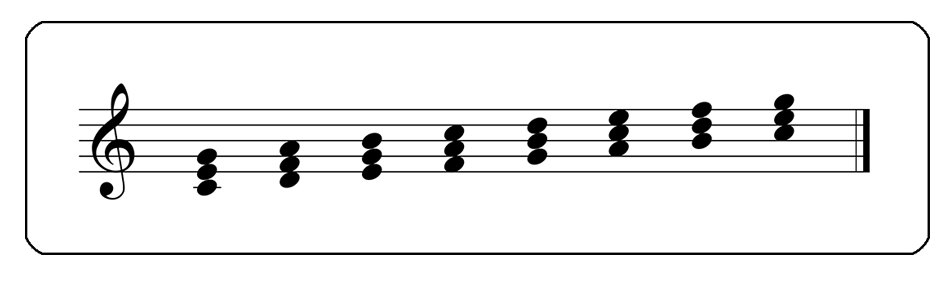
The chords from the harmony found in the key of C Major would result in:
C Major | D Minor | E Minor | F Major | G Major | A Minor | B Diminished
ASSIGNMENT:
For additional practice, compose a chord progression that applies diatonic chords found from within the key of, “C Major.”
These chords will sound well with each other since they share all of the same notes from the key signature (they are “Diatonic”).